Home Blog Page 92

What is Polkadot and How Polkadot does work?

Every day people interact with applications and technologies that are controlled by large or small organizations whose incentives will conflict with their personal benefits.

When people want to use and benefit from using such applications, they’re forced to tick their terms and conditions. Few people don’t even read and blindly hit the terms and conditions button. This way, the organization will have control over personal information i.e name, email id, address, mobile number, IP address, browsing history, etc. People also trust, their detailed information would be misused or stolen.

Similarly, the process performed in decentralized technologies such as blockchain has been denoted as they prioritize user’s sovereignty across the centralized control. As new systems are introduced, user’s aren’t required to trust third parties.

The truth is, blockchain technology is keeping the promise and struggling harder to build trust. The progress is going on till the date.

Thanks to Polkadot (DOT) – Decentralized blockchain interoperability platform.

Polkadot (DOT) is ready to deliver a powerful robust platform for Safety, Security and Scalability.

What is Polkadot (DOT)?

Polkadot (DOT) is the “next-generation blockchain protocol” that exhibits cross-chain transactions of any type, token, data or asset. Thereby, Polkadot (DOT) is making a massive amount of blockchain interoperable with one another.

Polkadot (DOT) will connect multiple blockchains into a single “unified network”. This blockchain protocol is specially designed for websites and applications. It offers complete control to users over the company’s terms and conditions or internet monopolies.

The feature “interoperability” seeks to build a completely decentralized and excellent private web. Finally, everything is controlled by the individual. Polkadot (DOT) is simplifying the process for new applications and services.

Everyone around the world is keeping their eyeballs on PolkaDot. Because this protocol connects networks, public chains, private chains, oracles and upcoming technologies. Here the independent blockchains can share personal data and transactions via the Polkadot (DOT) relay chain.

Who are the Founders of Polkadot (DOT)?

Polkadot was founded by three people.

  • Dr Gavin Wood (Co-founder of Ethereum)
  • Robert Habermeier and
  • Peter Czaban

Polkadot was introduced by “Web3 Foundation” in 2016. The aim is to deliver open-source user-friendly decentralized web.

Gavin Wood is a famous person as he developed the coding language “Solidity”. The language used to develop decentralized applications on Ethereum. Wood took part in Ethereum creation. He also worked in Microsoft as a research scientist.

The co-founder Wood established “Party Technologies” in 2015. The ultimate goal is to develop user-friendly projects to build on “Ethereum”. Currently, Party Technologies is maintaining “Substrate”. It is the software development framework used by developers at Polkadot. With this framework, developers can create parachain in no time.

Robert Habermeier is a well-known researcher and developer of blockchain technology. Peter Czaban is the W3 foundation’s technology director. Czaban is developing the latest generation of “distributed technology”.

What makes Polkadot (DOT) Unique?

Many chains, one network

Polkadot is popularly called the “Sharded blockchain”. It means, Polkadot connects multiple chains within a single network. It allows blockchain to process information and transactions simultaneously with security guarantees.

Heterogenous sharding model

Million thanks to Polkadot (DOT)!!! Every blockchain in the network is optimized according to individual users rather than forcing the user to adapt to the “one-size-fits-all model”.

Blockchains that grow

A single blockchain may not be sufficient for decentralized applications in the future. The drawbacks in early blockchain are less throughput and lack of runtime. This is making blockchain impossible for scaling in multiple real-world use cases. 

With the bridge, multiple blockchains together into a single network, all the transactions are performed parallelly. Ultimately, it eliminates the bottlenecks that have been encountered in previous cases while processing transactions.

As per analysis, Polkadot will also grow in the future by introducing nested relay chains. It will increase the shard counts that can be easily incorporated into the network.

Transparent Governance

Polkadot (DOT) is powered by the community. Considering blockchain, no third-party or governance procedure is involved. The individual has no power to propose any change.

Polkadot (DOT) works differently. This protocol can be governed by any individual who is owning DOTs. All the stakeholders can propose any change or modification to the existing proposal. Also, stakeholder’s can help while electing the council members.

Cross-chain composability

The blockchain design just looks like a closed garden. It means, one network cannot communicate with another network. Polkadot (DOT) tokens offer cross-chain composability. Also, message passing functionality allows individuals to communicate with each other and share information. With a bridge, Polkadot shards can also communicate with decentralized finance protocols and outside networks such as Ethereum.

How many Polkadot (DOT) tokens are there?

Let’s have a look at the number of Polkadot tokens that existed in circulation.

As per reports, there are currently 1 billion Polkadot tokens allocated in circulation from the maximum supply of 10 million in Aug 2020.  These tokens have followed the rules of the network’s redenomination to avoid the usage of small decimals. The redenomination is used to make the calculation simpler.

Polkadot’s initial token purchase closed on October 27, 2017, growing a total of 485,331 ETH. 

There is no maximum supply for Polkadot tokens. Polkadot is inflationary. The market rank of Polkadot (DOT) is 9. Currently, DOT token price is $19.32. The price value changes from time to time.

How does Polkadot (DOT) work?

Polkadot (DOT) allows transactions from multiple chains in the network at the same time. These can be optimized according to specific usage.

Polkadot has 3 core components
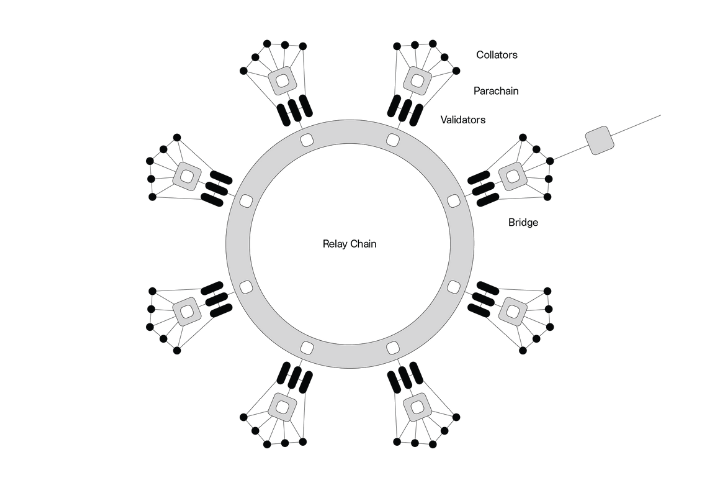
Relay chain – It’s considered the core layer of the network. At the Relay chain, bookkeepers will overlook all the network transactions.

The relay chain is the heart of Polkadot’s network. The chain helps to create constant, interoperability and security around the network of multiple chains.

Parachain – This is made of individual blockchains that are connected in a parallel manner.

Parachains = Parallel Blockchain

The individual chain will have its own tokens that can be optimized for individual use cases.

Bridges

The bridge allows parachain to communicate with the established or external chains such as Bitcoin, Litecoin, Ethereum and more. The technique “Break-in and Break-out” smart contracts allows other blockchains to communicate with each other on the Polkadot network.

Advantages of Polkadot (DOT)

Polkadot (DOT) design is offering amazing advantages over traditional and legacy networks. It includes

  • Heterogeneous sharding
  • Scalability
  • Transparent governance
  • Cross-chain composability
  • Upgradeability

Conclusion

Polkadot (DOT) is the next-generation blockchain protocol. This software combines the complete network of blockchain. It allows them to process or operate together at scale. Since Polkadot enables different types of information to be sent or received between any type of blockchain. Finally, with Polkadot, a massive range of use cases have been unlocked across the world. Polkadot (DOT) has three main components, relay chain, parachain and bridges.
What is ethereum and How does ethereum work?

Over these past few months, cryptocurrencies have been creating a huge buzz. One tweet from Elon musk about bitcoins has stirred interest among amateurs about cryptocurrencies. The most frequently heard cryptocurrency is bitcoin. The whole concept of cryptocurrencies and blockchain is to eliminate the interference of financial institutions or banks. This could revolutionize the way people conduct transactions too.

But apart from bitcoin, there are many cryptocurrencies that the world needs to know and are slowly rising to the top. One such coin is ethereum. If you are a crypto enthusiast and are looking for information on these currencies to become the best investor then you are at the right place. In this article, you will learn all the information about ethereum and how it works.

What are you waiting for? Let’s dive right into the topic.

What is Ethereum (ETH)?

This is a technology that is run by a community to power the cryptocurrency-Ether (ETH). Not only Ether, but it also helps run thousands of other decentralized applications too. This cryptocurrency is open to everybody. Ether is the second-largest cryptocurrency in the world. The most common mistake that most people make while talking about Ethereum is cryptocurrency in itself.

However, Ethereum is an open-source blockchain that is decentralized and Ether is the own cryptocurrency of the Ethereum platform. It also works as a platform for other cryptocurrencies too. Ethereum also facilitates the implementation of decentralized smart contracts.

The primary goal of Ethereum is to allow users across the globe to run and write softwares that defy downtime and fraud. The downtime of software or server can slow down the translation or sometimes the transaction is failed. Ethereum wants to become a worldwide platform for decentralized applications. 

Who are the founders of Ethereum (ETH)?

Ethereum has eight co-founders. Yes! Each of these co-founders has a definite role in the founding of the second-largest cryptocurrency. Ethereum (ETH) has first made its appearance in the Whitepaper by one of the co-founders Vitalik Buterin in 2013. Other co-founders include Gavin Wood, Charles Hoskinson, Joseph Lubin, Mihai Alisei, Anthony Di Iorio, Amir Chetrit, Jeffery Wilcke. 

This cryptocurrency has a long list of founders. However, this cryptocurrency was founded first by Vitalik Buterin, Charles Hoskinson, Amir Chetrit, Anthony Di Iorio, and Mihai Alisie in December 2013. In 2014, Gavin Wood, Jeffery Wilcke, and Joseph Lubin were added as founders. Later in 2014, Charles Hoskinson left the project. Amir Chetrit has also helped in the early stages of Ethereum development and later stepped away.

Vitalik Buterin is a Russian-Canadian who is still working to improve the Ethereum platform. Before co-founding Ethereum, he was also co-founder and also wrote for the Bitcoin Magazine Website. 

Charles Hoskinson has played a significant role in starting the swiss based Ethereum foundation along with its legal framework.

Mihai Alisie has assisted in starting the Ethereum foundation.

Anthony Di Iorio and Joseph Lubin have funded the project in the initial stages of Ethereum development. 

Gavin Wood, a British programmer who implemented the first and foremost Ethereum technical implementation in the C++ language. 

What makes Ethereum (ETH) unique?

As you already know, Ether is the global digital currency and the primary asset of the Ethereum platform. However, have you ever wondered what makes this particular cryptocurrency so unique? First of all, it is highly different compared to traditional money. Here are a few reasons why it is so unique.

No Intermediaries

Imagine how trouble-free it would be if you could be your own bank? No more delay in transactions and no more high transaction fees. Lastly, there are also fewer chances of your falling Prey to any fraudulent activities. This is what Ethereum offers, with this platform you can manage your own funds with the wallet without any third-party involvement. The wallet acts as your proof of ownership. Ethereum has made peer-to-peer payments simple, easy, and secure.

Cryptography security

Since Ethereum is digital most people are worried about whether it is secure or not. For all the people worrying about security. Ethereum is safe because it is secured by cryptography. It protects your transactions, ETH and Wallet. 

Decentralized & Open

Ethereum is decentralized. Basically, no bank or company in the world can print more Ether coins. They can not change the terms of use also. So this digital currency is secure and independent. Another interesting thing about Ethereum (ETH) is, all you need is a stable internet connection and a wallet that accepts Ethereum. People don’t have to access bank accounts to make and accept payments anymore. 

Available in Fractions

Another unique thing about this cryptocurrency is that people don’t have to buy one whole ETH. Since it is visible upto 18 decimals they can buy fractions of the coin if you want.

Smart contracts

Ethereum has made smart contracts easy. Smart contracts are the computer programs that will automatically execute the contracts when the necessary agreements of the involved parties are fulfilled. With Ethereum the need for trusted intermediaries reduces so the transaction prices whilst increasing the transaction reliability.

How many Ethereum (ETH) coins are there?

As of August 2020, 112 million Ethereum are in Circulation. The data about the maximum supply of ETH coins are not available. In 2014, they secured funding for the project through an online public crowd sale. In the 112 million, around 60 million were given to the contributors from the public crowd sale. Another 72 million was allocated in the first-ever block of Ethereum- genesis block. 12 million was given as the development fund. All the remaining amount of coins were issued as rewards to the miners on the network. The 24 hours high price of Ethereum was $2,840.44 and the 24 hours low time price was $2,540.68. 

How does Ethereum (ETH) work?

The similarity between Ethereum and bitcoin is the blockchain. However, the programming language of Ethereum makes it easy to write and run softwares that manage blockchain transactions and automates the outcomes. The smart contract terms are written within the code, so the smart contracts (computer program) will ensure that the contract is executed as soon as all the agreement terms are met. The Ethereum platform is making an entry into several industries already. And it makes it easy to manage the contracts and reduces the costs and the time and effort to reduce the manual processing of the required documents. 

Wrapping up

Ethereum blockchain was launched on July 30, 2015. Along with the smart contracts it also hosts other cryptocurrencies known as tokens. The average time to mine an Ethereum block is about 13-15 seconds. By the time you finish reading this article at least, 10 blocks would have been mined right? Found this article interesting, wanna know more about the world of blockchain and cryptocurrencies then head to Postling

Exploring the pros and cons of paper trading account

Traders should use the demo account so that they can trade properly. But, some traders don’t use the account and directly start trading in the real market. And so, they face huge troubles. Actually, before jumping into the real market, you should know about the market. For this, you need to gather practical experience. But, if you can open a demo account, you might easily get to know about the different types of facts and terms of the market. Every newbie should know about the advantages of having a demo account.

In this post, we will discuss the advantages of using the demo account. We hope, it would become helpful for you. Let’s know about these.

Understand the risk of the market

Every trader should identify the risk factors of the situation. Otherwise, it’s not possible to limit the loss. To go ahead, traders should apply the right risk management technique which might aid you to manage the risk. Some traders, due to lack of idea, fail to minimize the risk and thus fail to earn money. So, to solve this issue, they should use the demo account which will help them to determine the risk factors. However, to develop the risk development skills, you need to practice regularly. Otherwise, it would be tough for you to stay.

Develop the technical skills

If you can’t develop your technical skills, you might face problems using the different types of tools and indicators. The indicators help the traders to identify the major trends. If they can go with the trend of the market, they might do well. However, some traders fail to use the indicators correctly. And so, they fail to make the right decision. But, through the proper practice, it can be easy to learn about the proper application of the indicators or tools. Besides this, you might learn how to interpret the price action chart. Once you learn to ply the price action strategy in online options trading profession, you might be able to get success. So, start working hard and try to develop your technical skills.

Help to become confident

Without being confident, you can’t make a wise decision. Traders should know the proper way of trading. If they know how to solve the issues, they might get the confidence for trading. Many professionals also use the demo account during the middle of the trading to get back their confidence. Due to a lack of confidence, some traders don’t open any new positions and thus fail to fulfill their dream. However, if you want to become successful, you should acquire the proper knowledge about the market which will aid you to develop your confidence level.

Do the backtesting

Some traders fail to use the strategy properly. So, traders should use the plan in the virtual market. As a result, they will understand whether the plan will work or not. However, sometimes, by making a good plan, traders become confused. But, if they become used to the plan, they might not face any issues. Besides this, in the virtual market, if your plan does not work properly, you might not face any issues.

Help to make large profits

Remember, trading is not an innate skill. If you practice more and more, you might get success. But, if you become lazy and don’t have thirst for learning a new thing, it would be tough for you to do well. So, you should practice properly to develop your skills. Skilled traders can easily make money. On the other hand, the traders who have a lack of experience can’t be the winner.

So, if you want to become the master of trading, you should use the demo account. Or else, it would become tough for you to achieve your goal. Bear in mind, if you don’t practice in the virtual field, you’ll face problems in the real field.

What is Litecoin and How does Litecoin work?

For the past few years, people have been showing interest in cryptos such as Bitcoin, Litecoin, etc. With advanced technology, investors are choosing cryptocurrency during payments. “Bitcoin” is the dominant cryptocurrency and first digital currency introduced in the market.

Hundreds of cryptocurrencies have been created so far. Among them, Litecoin stands out from the crowd.

Similar to bitcoin, Litecoin is the popular decentralized P2P digital currency. The transactions processed over the network are powered by the blockchain protocol.

Litecoin made people’s lives easier. They can make their payments from anywhere to anyone around the world.

No more waiting!!! Send or receive payments at high speed. The expressive part of Litecoin is, the transaction cost is cheaper compared to other payment modes and other assets.

What is Litecoin (LTC)?

The short form of Litecoin is “LTC”. Litecoin is the top and long-standing cryptocurrency. Litecoin (LTC) was introduced by Charlie Lee in October 2011. Similar to Bitcoin, LTC is based on a peer-to-peer decentralized network, no third party or central bank is involved.

It’s an open fact that Bitcoin (BTC) and Litecoin (LTC) are popular types of cryptocurrency. Did you know, the crowd over BTC is enormous? Yes!!! Since the value of Bitcoin is increasing day by day, investing in LTC (LTC) could be a good idea. Litecoin is the 9th largest cryptocurrency.

During the initial days, Litecoin was one of the top competitors to other cryptocurrencies such as Bitcoin, Ethereum and more. However, cryptocurrency has become interesting with its new offering in recent years. Litecoin has also gained popularity.

Though Litecoin is similar to Bitcoin (BTC), there are few aspects that make a huge difference i.e

  • Fast block generation rate
  • Cheapest payment solution
  • Uses Scrypt

Litecoin (LTC) is an alternative to Bitcoin. But, it has overcome few challenges that have been encountered in Bitcoin. Just by introducing a few changes and alterations to the existing Bitcoin programming code, Litecoin is ready with faster transactions and fewer processing charges.

Who are the founders of Litecoin (LTC)?

Charlie Lee is the creator of Litecoin (LTC). He is a computer scientist, Lee worked in Google and provided his services for Google Chrome OS. In the year 2011, Charlie Lee showed interest in Bitcoin. He worked on blockchain technology during his free time while working at Google. With dedication, Lee released Litecoin to the market. Charlie has mined just 150 coins.

Charlie Lee said – He is not intended to give a competition to Bitcoin but wants to use Litecoin for small transactions. After two years i.e 2013, Charlie Lee has left his job at Google and started working on Litecoin at Coinbase.

What makes Litecoin (LTC) unique?

Litecoin is the first longest-standing altcoins created by Charlie Lee. If you’re looking for investment, Litecoin is the solution for you. Litecoin is the upgraded version of Bitcoin. There are several unique features of Litecoin.

High Transaction Speed 

Litecoin inventor Charlie Lee wants to overcome the drawbacks of other cryptocurrencies. So, Charlie has paid attention to transaction speed. Finally, he succeeded by providing high-speed transactions in Litecoin.

1 Litecoin transaction speed is 4 times faster than other cryptocurrencies. Litecoin is perfect for one who is looking for faster transaction speed.

Transaction cost

Let’s have a look at the transaction cost of Litecoin.

It’s a universal fact that the transaction cost is cheaper for digital currencies. Hence, the transaction cost of Litecoin is cost-effective.

Compared to other digital currencies, Litecoin offers cheaper transaction charges. Everyone should agree that the transaction fee of Bitcoin or Ethereum is higher than Litecoin.

Scalability 

For the past few years, people have been investing in Bitcoin. But the fact is, Bitcoin is striving with the “scalability” functionality. In other words, investors cannot perform multiple transactions at the same time. Hence, Bitcoin needs to increase its transaction fee. This could be harder for investors. While with Litecoin, investors can send or receive money at low transaction costs. As a result, Litecoin users can perform multiple transactions at the cheapest cost.

More decentralized

The founder Charlie Lee was concentrating on high speed and low transaction costs. He also focused on “Extraction of more number of Litecoin’s”. Yes, you’ve heard it right. Litecoin (LTC) is providing a centralized minimum system.

Let’s consider, Litecoin accounts for more than 71% hash rate for 5 mining pools. While other cryptocurrencies, 6 mining pools will make upto 60.4% hash rate.

Cryptocurrencies such as Bitcoin, Litecoin and Ethereum have similar centralized mining processes. But, bitcoin and other cryptocurrencies are less centralized when compared to Litecoin.

How Many Litecoin (LTC) Coins have existed?

As mentioned earlier, Literreoin is the 9th largest cryptocurrency. Bitcoin and Litecoin have finite coins available in circulation. The approximate number of Litecoins (LTC) is 84 million will be created in the circulation. There are 66.245 million Litecoin’s that are mined by the end of 2020.

The team Litecoin researched and estimated the coin growth will be extremely well until 2140. Because the total number of Litecoins that are mined every block will be decreased every 4 years.

Over 5 lakhs of Litecoins (LTC) were mined per day. Charlie Lee and other developers are considered the first miners of Litecoin.

Litecoin will build new blocks every 2.5 minutes.  It is 4 times faster than BTC (Bitcoin). The network will create a new block for every recent transaction around the globe.

Litecoin has a better future. As per analysis, LTC province will reach $250 by 2022. Sounds interesting right? Yes!!! Litecoin is the safest investment option.

How does Litecoin (LTC) Work? 

Litecoin is a powerful peer-to-peer digital currency, it means LTC is not owned or administered by a bank or central authority.

Since the block confirmation duration is 2.5 minutes, Litecoin (LTC) network provides high transaction speed and less transaction fee. The payments can be processed by an individual or a group of people around the world. The transaction performed between two people is recorded simultaneously on the blockchain.

Bitcoin (BTC) and Litecoin (LTC) work on similar fundamentals. Litecoins are mined, orphaned blocks will occur at the end-stage. Orphaned blocks are nothing but blocks that are created by two different miners at the same time. At that moment, the chain will accept these two blocks. Later on, one blog will get rejected. Rejection of blocks can be done using “Segregated Witness” (SegWit).

Litecoin uses another technology i.e Atomic Swaps. This technology offers interoperability to the blockchain. 

Atomic swaps expedite a peer-to-peer exchange of two cryptocurrencies such as BTC or LTC on multiple blockchains. By implementing “Smart Contract Technology” eliminates the intermediaries. Atomic swaps can be performed on-chain and outside the p2p network. Ultimately, investors can save money with Atomic swaps technology.

Cryptocurrencies such as Bitcoin, Litecoin and Ethereum use PoW algorithms (proof-of-work) to offer safety and security through the network.

Conclusion

Litecoin is the popular and first altcoin introduced by former Google engineer – Charlie Lee. LTC is similar to Bitcoin (BTC), except Litecoin is even lighter and super faster. There are 84 million Litecoins created. Over 66 million Litecoins are circulating in the market. Litecoin uses Atomic swaps, Smart contract technology and PoW algorithm to provide better security on the network. The key benefits of Litecoin are speed, cost, faster block generation, interoperability and decentralisation.

What is ripple and How does ripple work?

While cryptocurrency investment is synonymously viewed as bitcoin alone, there are several digital currencies in the market with many diverse functions, features, and market caps. Ripple Labs’ XRP, which is currently ranked 6th in the total market cap- is one of the rising digital currencies that investors are looking at. In this article, know all about Ripple- what is Ripple, what is XRP, how does it work, and what makes XRP unique. Scroll down to read more.  

What is Ripple (XRP) ?

Ripple is a currency exchange network that processes payment settlements by acting as a transaction facilitator between two parties and makes sure that the transactions are correctly done in a systematic manner.

Ripple, the parent company, uses XRP- the cryptocurrency as the medium of exchange to facilitate the transactions of assets exchange, payments, and remittance systems (an informal arrangement to transfer funds domestically and internationally without using recognized or formal financial institutions of respective countries).

Whenever a said user makes a transaction using the Ripple network, as a part of fee, the network deducts a predetermined amount of XRP based on the transaction amount. While making cross-border transactions, the standard fee is set to 0.0001 XRP, which is way cheaper than what financial institutions such as banks deduct generally.

How does Ripple (XRP) work

As mentioned above, while Ripple is the company that facilitates the exchange network system, XRP is their standard cryptocurrency through which the transactions are measured and conducted.

While cryptocurrencies, in general, give access to the transaction ledger to anyone who solve the equations quickly and leads the verification process, the Ripple network has a model of “node lists” which lets the users build their list of trusted validators apart from the Ripple’s 35 default validators.

These 35 default trusted validators make up about six validation nodes (picked by Ripple)- in case users wish to pick the validators that are backed by Ripple.  Although anyone can download the validation software, users have the liberty to choose their validators whom they consider to be the participants who are less likely to defraud.

Through this centralized set up, the transactions are conducted seamlessly without having to involve the company for approving each individual transaction. 

Validators update the ledgers as and when the transactions occur every now and then to make sure that the records are updated and match the ledgers. Whenever they find a mismatch or any discrepancies, they immediately sit on the issue and find out what went wrong.

This way, the transactions which happen via Ripple are securely validated minimizing the risk of fraud. Unlike other cryptocurrencies like bitcoin where the transactions are validated after hours (with high charges), transactions via XRP are validated and confirmed within seconds- that too with low charges when compared to other cryptocurrencies. 

How to use Ripple (XRP) ?

Ripple can be used both as a transaction medium and as an investment avenue too. XRP, the digital currency of Ripple, is now widely used as a medium of currency exchange outside formal financial institutions.

Let’s say you want to swap Euros for Dollars. You can swap the Euros equivalent for XRP via Ripple medium and then process the transaction without having to pay hefty exchange rates at banks and financial institutions. This way, you can transfer money or remittances overseas in a much faster, easier, and reliable way, without having to spend much on exchange and transaction charges. 

What makes Ripple (XRP) Unique ?

While cryptocurrencies in general use blockchain mining technology, Ripple has its own exchange network that securely, efficiently and cost-effectively validates and confirms transactions where the nodes verify transactions via polls in a somewhat centralized manner. Here are some of the major points why Ripple is unique from other exchange networks.

Broader exchange network

Although Ripple has its own cryptocurrency to facilitate transactions, this network is also used to process transactions of other cryptocurrencies, commodities, etc apart from XRP. A faster and reliable exchange and validation is the major reason why Ripple has become a trusted exchange network in recent times. 

Low transaction charges

Unlike bitcoin, Ripple charges a nominal amount of XRP (0.0001 XRP) per transaction- which is very affordable when compared to other cryptocurrencies which charge high transaction charges at current rates. 

Quicker validation and settlements

XRP transaction validation occurs within seconds or minutes. Generally, the widely used transaction channels like wire transfers or bank remittances take hours or sometimes even days to process a transaction. Even if the transaction speedens up, the time taken for the value to reflect in the participant’s account is more- as the process requires complying to exchange rates, remittance taxes, etc.

With Ripple and XRP, the transactions are confirmed as and when it happens. In case of any issue, it usually takes minutes, which is however least when compared to bitcoin or other cryptocurrencies. 

Transaction platform

Several large financial institutions (banks, in particular) use Ripple as a transaction platform as the network is more centralized and efficient.

How many Ripple (XRP) Coins?

Speaking of the XRPs in circulation, the Ripple network has over 45,000 billion tokens inflow. Although almost 50 billion XRPs are stored in escrow for ensuring adequate liquidity and supply of timely XRPs, every month Ripple labs releases around 1 billion tokens or XRPs, most of which are catered to the demands of cryptocurrency exchanges, and to save in the escrow account for future supply.

However, since its inception, Ripple created XRPs of around 100 billion, of which only a part is in circulation. Unlike other cryptocurrencies, XRPs cannot be mined as the unused XRPs are timely escalated to an escrow account, which makes sure that there wouldn’t be any oversupply of XRPs and the market is not overflowing with the surplus in the long run.

This way, the value of Ripple net or XRPs is strongly tied to the market fluctuations, rather than the surplus or deficit. 

Conclusion

Although Bitcoin is widely known across the world, the focus of investors is slowly shifting to other promising cryptocurrencies like XRP. Ripple scores over bitcoin in the areas of transaction charges and transaction time as XRPs operate in a different way when compared to BTC. While Bitcoin is entirely a public system not backed by any organization, Government, or even under the purview of financial institutions for that matter, XRPs are run by a private company- Ripple net, which is now transforming as an exchange network even for major financial institutions. Want to know how other cryptocurrencies like Bitcoin work? Head to Postling blog.